
The Short Answer: Cleanroom standards are rules that set limits on airborne particles and air cleanliness inside controlled spaces used for manufacturing, research, and medical work. The most widely used system is ISO 14644, which groups cleanrooms into nine classes based on the number of particles allowed per cubic meter of air.
A cleanroom is a controlled environment where airborne contamination is kept within strict limits. Cleanroom standards give manufacturers and researchers requirements for how clean that air must be, which shapes everything from the filtration systems used to the type of furniture allowed inside. Different industries rely on different cleanroom classes, each defining the acceptable level of particulate contamination for the work being performed. This guide walks through the main cleanroom classification system, how cleanroom requirements vary by industry, and what to look for when outfitting a space to meet these rules.
The ISO Cleanroom Classification System
The International Organization for Standardization publishes ISO 14644, the most widely accepted cleanroom standard worldwide. ISO 14644-1 sorts cleanrooms into nine classes based on the allowed number of particles in the air at specific particle sizes. Lower ISO class numbers mean cleaner air with fewer airborne particles. An ISO Class 1 cleanroom allows far fewer airborne particles than an ISO Class 9 room. BEVCO designs seating to align with ISO cleanroom standards, helping facilities maintain compliance without adding contamination risk.
The table below shows a simplified view of how the classification system works.
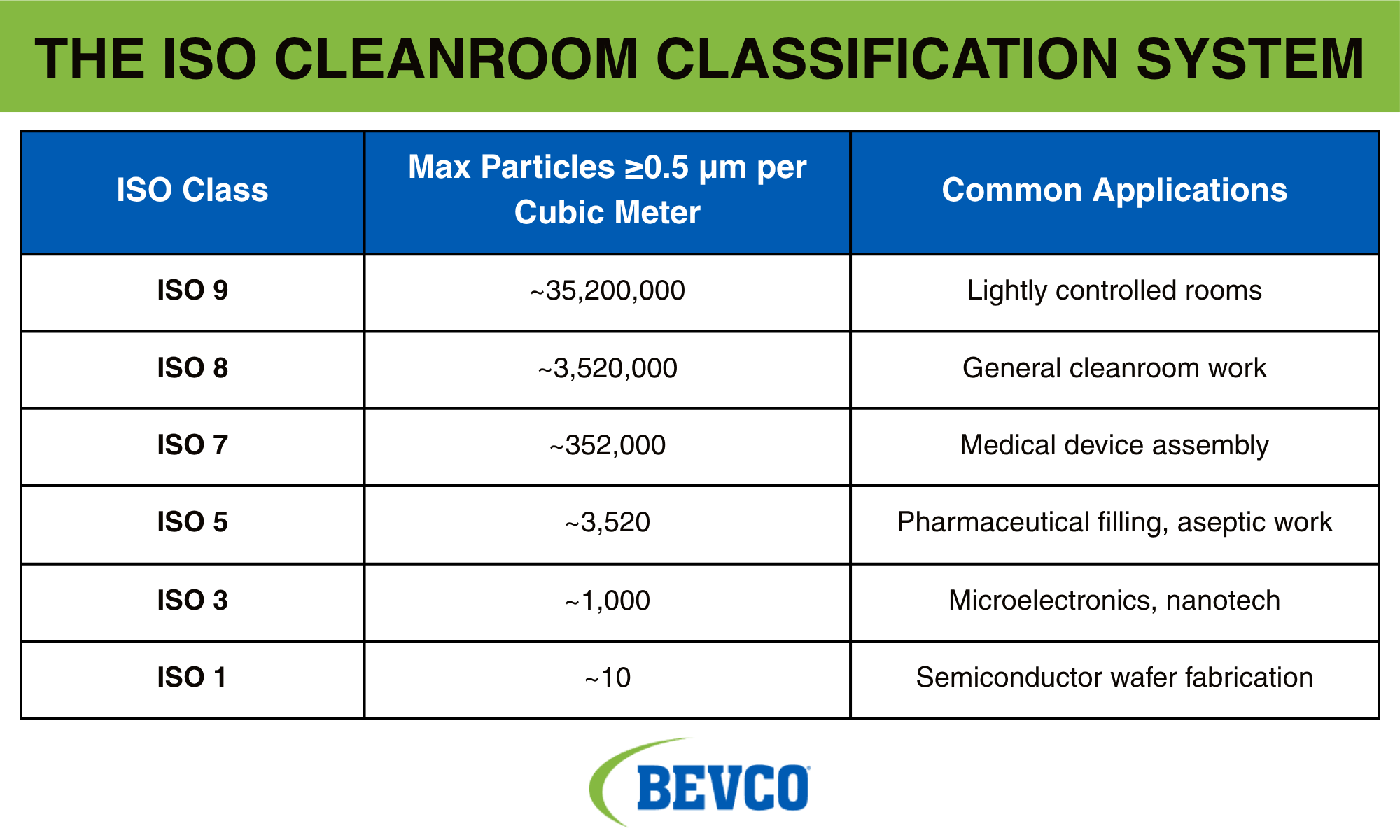
The difference between classes matters. ISO Class 5 allows about 3,520 particles (≥0.5 μm) per cubic meter, while ISO Class 7 allows about 352,000, making ISO 5 roughly 100 times cleaner.
In the U.S., the older Federal Standard 209E used different labels (Class 100, Class 10,000, and so on) but was retired in 2001 and replaced by ISO 14644 as the main ISO cleanroom classification reference. Most operators now speak in ISO terms because they match international standards and make it easier to compare sites around the world.
You can find the official ISO 14644-1 document through the International Organization for Standardization website.
How Cleanroom Requirements Differ Across Industries
Cleanroom applications vary based on what is being made and how sensitive the product is to particulate contamination. Sensitive materials like silicon wafers or injectable drugs need cleaner air than general assembly work.
Pharmaceutical Industry
The pharmaceutical industry follows ISO 14644 alongside Good Manufacturing Practice (GMP) rules. Sterile pharmaceutical products are often filled in ISO Class 5 environments or cleaner. The U.S. Food and Drug Administration publishes additional guidance on how these rooms should be monitored and maintained.
Semiconductor Manufacturing
Chip makers work in some of the cleanest spaces on Earth. A single dust particle can ruin a silicon wafer, so ISO Class 1 through ISO Class 4 rooms are common in semiconductor manufacturing fabrication plants.
Medical Device Production
Medical device makers typically run ISO Class 7 or 8 cleanrooms for assembly. Zones where sterile packaging takes place may be held to tighter cleanroom classes.
Other Cleanroom Applications
- Aerospace component production
- Biotech and gene therapy labs
- Optics and laser assembly
- Food and beverage packaging
- Nanotechnology research
Each of these uses the same ISO classification system, with different targets based on the product being made.
Core Elements of Cleanroom Design
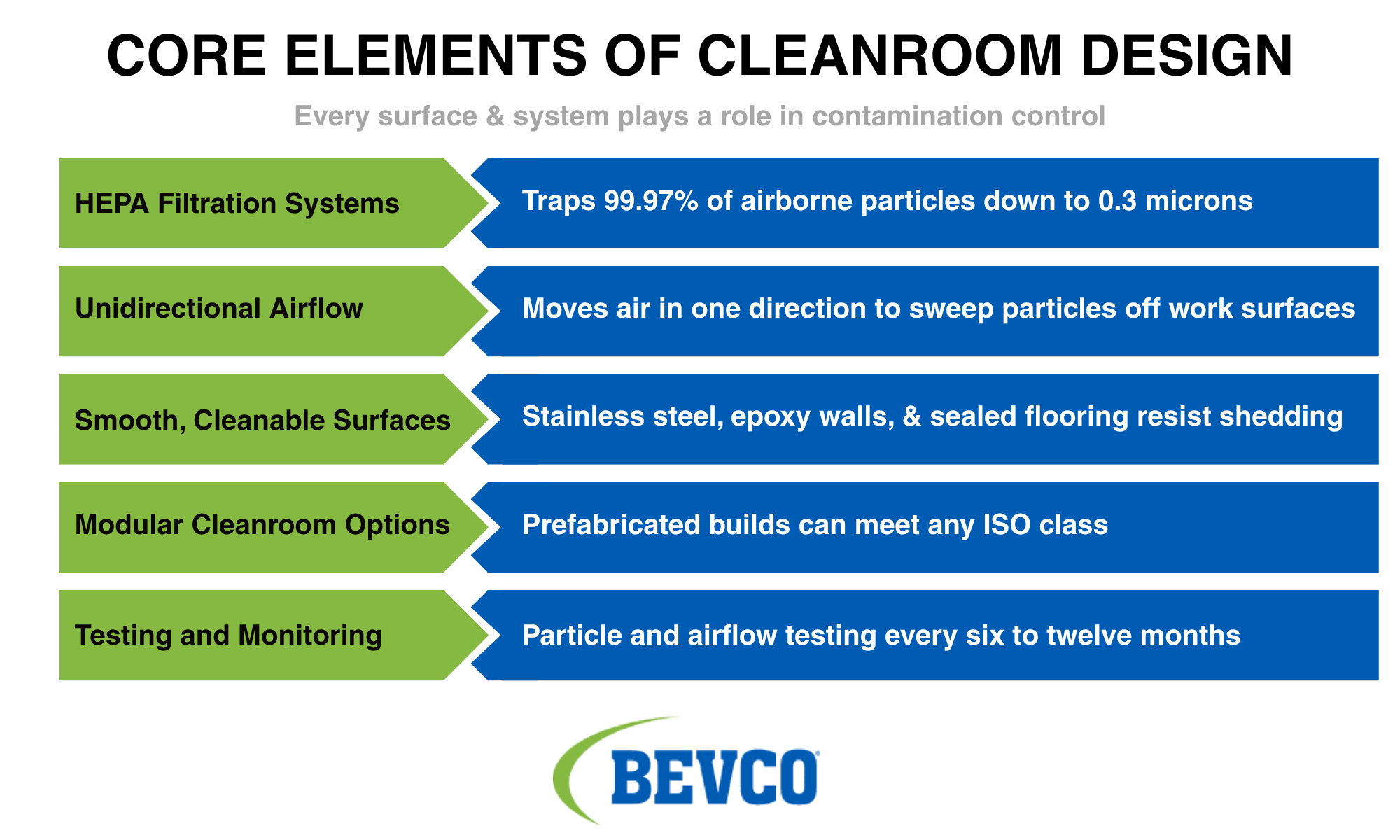
Every component inside a cleanroom, including seating, plays a role in maintaining these conditions. Building a cleanroom that meets international standards takes more than sealing off a space. Surfaces, air handling systems, and equipment all contribute to contamination control.
HEPA & ULPA Filtration Systems
High-Efficiency Particulate Air (HEPA) filter units remove at least 99.97% of airborne particles down to 0.3 microns in particle size. ULPA filters go further for ISO Class 1 through ISO Class 4 rooms. These filtration systems form the backbone of any cleanroom facility and are sized based on the room’s classification. Most rooms below ISO Class 8 require HEPA or ULPA filtration to meet particle count limits.
Unidirectional Airflow
In lower ISO classes, air moves in a single direction at a constant speed. This unidirectional airflow sweeps particles away from work surfaces before they settle. Higher classes may use turbulent airflow, which costs less to operate but allows more particle emissions to linger in the space.
Smooth, Cleanable Surfaces
Stainless steel, epoxy-coated walls, and sealed flooring are standard in cleanroom construction because they do not shed particles and hold up to frequent cleaning. Seating must meet the same standards. BEVCO’s cleanroom chairs are built with non-shedding materials like polyurethane and designed with smooth, sealed surfaces that are easy to clean and hold up to repeated sanitation.
Modular Cleanroom Options
A modular cleanroom is a prefabricated structure that can be built inside an existing facility. These setups give design flexibility for companies that want cleanroom installation without a full construction project. A well-specified modular build can meet the same ISO class as a traditional cleanroom.
Testing and Monitoring
ISO 14644-2 recommends yearly testing for classes above ISO 5 and every six months for ISO 5 and cleaner. Testing measures the number of particles in the air, airflow patterns, and pressure differences between rooms.
Static Electricity and ESD Control
In many cleanroom applications, static electricity is as much of a problem as dust. A static discharge can damage electronics, ignite solvents, or pull airborne contamination onto a product.
Electrostatic discharge (ESD) control matters most in semiconductor manufacturing, circuit board assembly, and work with sensitive materials. Common measures include:
- Grounded flooring and wrist straps
- ESD-rated garments and gloves
- ESD-rated furniture and seating
- Ionizers that neutralize charges in the air
- Humidity control to reduce static buildup
BEVCO’s ESD-rated chairs and stools help control static buildup and protect sensitive components during daily use.
Why These Standards Matter
Cleanroom standards protect product quality, worker safety, and the people who rely on what comes out of the cleanroom. A pharmaceutical product contaminated by airborne particles can harm patients. A semiconductor chip fouled by particle emissions can fail in the field. An aerospace part with embedded debris can cost lives.
Following an industry standard gives companies consistent product quality, compliance with federal standards and international rules, lower contamination risks, better audit outcomes, and easier comparisons across sites and regions. Choosing the right equipment, including properly rated seating, is part of maintaining these standards in day-to-day operations.
Matching Seating to Your Cleanroom
Cleanroom-rated furniture is an overlooked part of contamination control. Standard chairs can shed fibers, generate static, and use materials that off-gas in clean environments. BEVCO specializes in seating built for cleanroom and controlled environments, where material choice and construction directly impact contamination control.
At BEVCO, we have been building seating for cleanroom and ESD applications since 1947 at our U.S.-based manufacturing facility in Waukesha, Wisconsin. Our cleanroom seating and ESD/cleanroom seating options are built with polyurethane and other low-shedding materials that match the requirements of ISO classified spaces. We also build chairs and stools for laboratory and manufacturing environments with similar contamination control needs.
If you are outfitting a cleanroom facility or updating existing seating, our team can help match the right chair or stool to your ISO class. Use our Chair Configurator to explore options, find a distributor in your region, or contact us to talk through your cleanroom setup.