
The right chair height keeps your feet flat, your knees near a 90-degree angle, and your forearms level with your work, so you stay supported throughout a full day. Because that fit depends on the surface you work at, a desk, a counter, and a lab bench each call for a different seat height.
Whether you are outfitting one office worker or a full floor of employees who sit for long stretches, the right height adjustment is where comfort starts.
Bevco’s Seat Height Calculator will help you determine the optimal seat height range you need for your work surface.
STEP ONE:
- Measure the height (in inches) from the top of your work surface to the floor. This is your work surface height.
STEP TWO:
- Enter this measurement (work surface height) into box 1 on the diagram and it will calculate the optimal seat height in box 2.
SEAT HEIGHT CALCULATION:
Work Surface Height:
Optimal Seat Height:
Seat Height Range:
Understanding Chair Height
Getting the chair height right starts with learning what a few of these terms mean.
Work surface height: The distance from the floor to the top of the desk, counter, or bench you work at. This is the measurement you enter into the calculator.
Seat height range: The span between a chair’s lowest and highest positions. A Bevco chair adjusts across its range so one chair can fit a spread of users and tasks.
Midpoint: The center of the seat height range, found by subtracting 10 inches from your work surface height. Your ideal seat height sits here, with room to adjust above and below.
Optimal seat height: The height that puts your feet flat, your knees near a 90-degree angle, and your forearms level with your work.
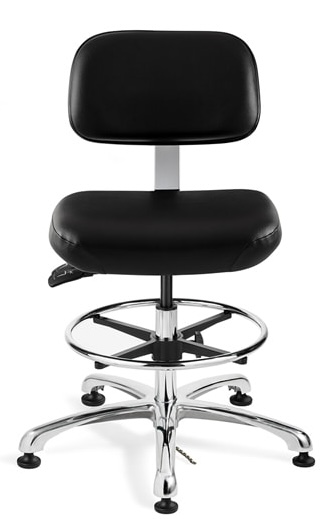
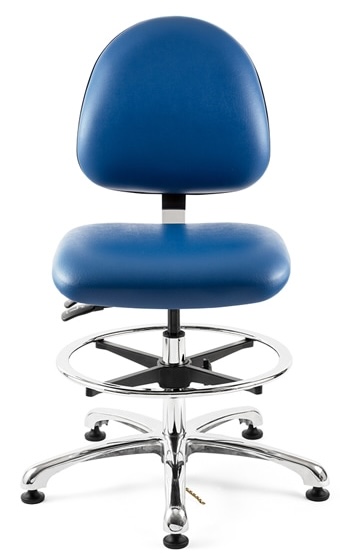
Footring: The round bar near the base of taller chairs. When the seat is too high for your feet to reach the floor, the footring supports your legs and improves lower body circulation.
Swivel: A 360-degree swivel seat lets you turn to reach your work without twisting your back, standard on every Bevco chair.

How the Calculator Finds Your Range
The rule behind the number is simple: subtract 10 inches from your work surface height, and that is the midpoint of your ideal chair height. Your seat should then adjust at least 2.5 inches above and 2.5 inches below that midpoint.
The 10-inch drop is where most adults land when their elbows rest near a 90-degree angle at the surface, and the range on either side leaves room to fine-tune the fit once you sit down.
Every body is different, so treat the result as a starting point; you adjust to your own setup. A wide height adjustment range is what lets a single chair stay comfortable across different users and work surfaces.
Bevco’s Three Chair Height Ranges
There is no single standard chair height, because the right height follows your work surface. A standard desk falls in the desk-height range, while raised counters and benches move you up into mid or tall height. Bevco builds three ranges to cover the full spread:
Desk height, approximately 15 to 22 inches, for a standard desk or table.
Mid height, approximately 18 to 28 inches, for raised benches and counter-height work surfaces.
Tall or bench height, approximately 22 to 32 inches, for the highest work surfaces.
As the seat rises, your feet no longer reach the floor, so an adjustable footring on mid and tall chairs supports your lower body and takes pressure off your thighs. That extra height is what makes a counter or bench workable without leaving your legs unsupported.
Every Bevco chair is built to order in the height range you choose.


Chair Height Is One Measurement Among Several
Seat height sets the foundation, but a few other adjustments decide the final fit. Seat depth, back height, arm height, and the angle of the seat/back all shape how the chair supports you, so set them together once your height is dialed in.
A comfortable seat is the product of all of these working together, not height alone. One chair can serve different purposes across a workday, from focused desk work to quick tasks at a bench, as long as its height and function are set to fit.
For standing or adjustable desks, measure the surface at the height you actually work at, and if your feet do not reach the floor at your ideal seat height, add a footrest rather than dropping the seat. Our ergonomics best practices cover the rest of the setup.
Frequently Asked Questions
How do I measure the right chair height?
Measure from the floor to the top of your work surface, then subtract about 10 inches. That is the midpoint of your ideal chair height, and your seat should adjust at least 2.5 inches above and below it.
What if I fall between two chair height ranges?
Choose the range whose midpoint sits closest to your calculated seat height. Because every Bevco chair adjusts at least 2.5 inches above and below its midpoint, the overlap between ranges usually covers the gap.
Can I try a BEVCO chair before I buy it?
Yes, through the Sample Program. Send your distributor a purchase order for the chair you configured; Bevco ships it in 5 to 7 business days, and you evaluate it for 30 days. Keep it, and you pay the invoice; return it within 5 days of the evaluation period if it is not the right fit. If you have questions about sizing or your order, Bevco customer service can point you to the right distributor.
Ready to Put Your Measurement to Work?
Once you know your seat height, our Chair Configurator builds the right Bevco chair around your specific needs: your series, base, height range, and options in one place. Every chair is made to order, so you can match it to your exact work surface before it ships.