
When it comes to workplace productivity, equipment often gets the spotlight: machines, tools, workstations, and technology. Yet one of the most important pieces is often overlooked: the chair. An industrial drafting chair is a tall, footring-equipped chair built for elevated work surfaces like benches, lab counters, and assembly stations.
For employees working at elevated workstations, assembly benches, laboratory counters, inspection stations, or technical work surfaces, the right industrial drafting chair can significantly impact comfort, productivity, and overall workplace well-being. Choosing the wrong chair can lead to fatigue, poor posture, discomfort, and even lost productivity over time.
If you’re outfitting a manufacturing facility, laboratory, cleanroom, electronics production area, or technical workspace, this guide will help you understand what to look for in an industrial drafting chair and how to make the best investment for your team.
Why Industrial Drafting Chairs Matter
Unlike traditional office seating, industrial drafting chairs are designed for elevated work environments. They provide the additional height, support, and durability required for workers who spend extended periods at benches and workstations that sit above standard desk height.
Employees who lack proper seating often compensate by leaning forward, resting on one leg, or perching on the edge of a chair. Over time, these habits can contribute to discomfort in the back, shoulders, neck, and legs.
A properly selected drafting chair helps workers maintain better posture, stay comfortable longer, and focus on their tasks rather than physical discomfort.
Step 1: Determine Your Work Surface Height
The first and most important consideration is workstation height. Selecting a chair without understanding the height requirements of the workstation can result in poor ergonomics, regardless of how many features the chair offers.
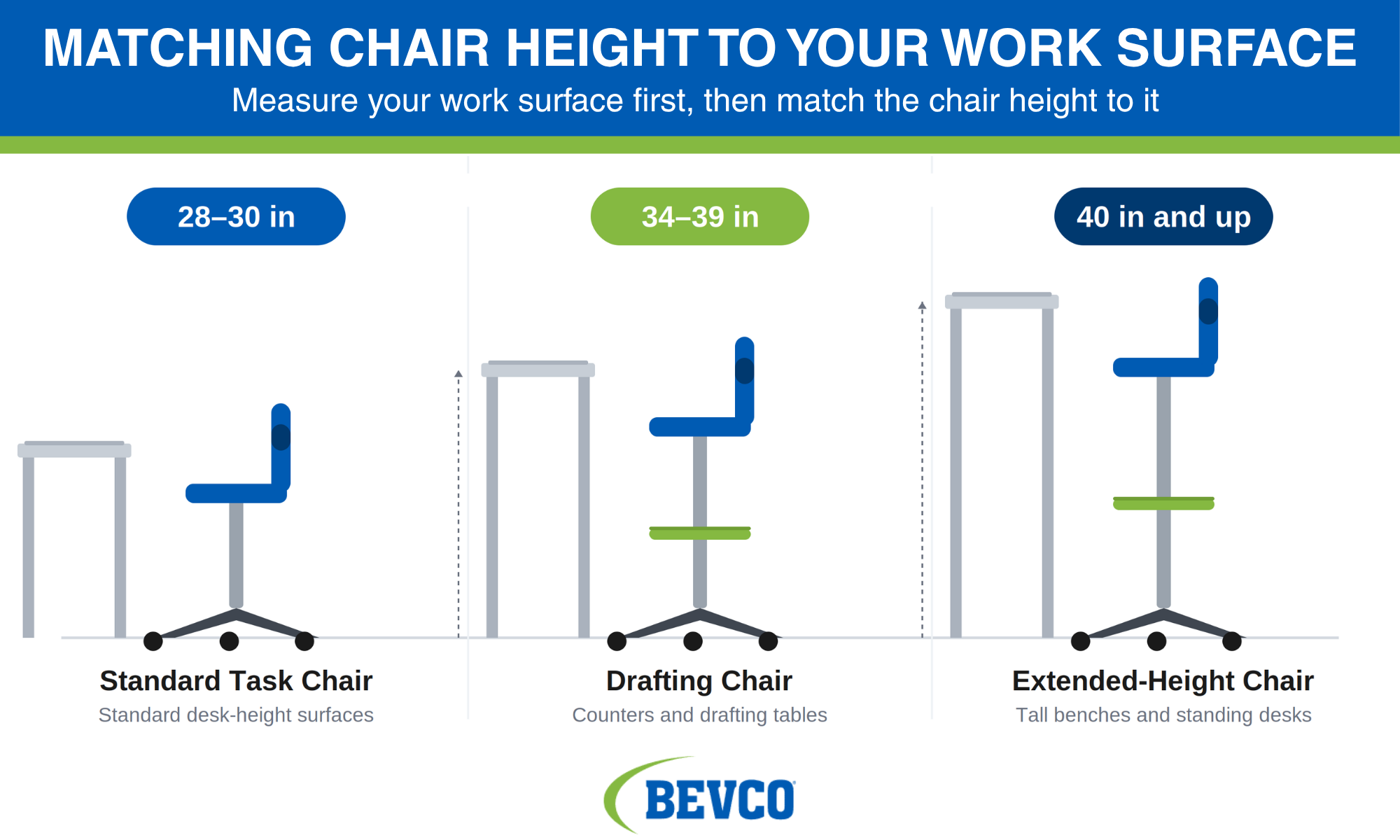
As a general guideline:
- 28–30-inch work surfaces: Standard task chair
- 34–39-inch work surfaces: Drafting chair
- 40-inch and higher work surfaces: Extended-height drafting chair
Employees should be able to work comfortably with their shoulders relaxed and elbows positioned at approximately 90 degrees. Their feet should also be properly supported, either on the floor or on an adjustable footring.
When evaluating drafting chairs, pay close attention to the seat height range and check that it covers your workstation dimensions. If you need help, use Bevco’s Seat Height Calculator to determine your optimal seat height range based on your work surface height.
Step 2: Understand the Working Environment
Industrial environments vary widely in their conditions, characteristics, and operational demands, and those differences directly influence what workers need from their seating. A manufacturing plant, a warehouse, and a research facility each present their own challenges: different tasks, safety regulations, and ergonomic needs that all factor into the right seating choice. Assessing these requirements up front is what gives you seating that keeps workers comfortable while supporting productivity and safety.
Manufacturing and Assembly Areas
Manufacturing facilities often expose seating to oils, grease, dirt, metal shavings, and continuous use. In these environments, durability should be a top priority. Chairs should withstand daily wear while remaining easy to clean and maintain.
Important things to look for:
- Polyurethane seating
- Heavy-duty construction
- Chemical resistance
- Replaceable components
- Stable bases designed for industrial settings
Laboratories
In laboratory environments, seating needs to sanitize easily and stand up to cleaning agents and chemicals. The materials have to be durable enough to handle frequent exposure to harsh cleaning solutions and built so they can be wiped down and disinfected thoroughly. Ergonomics matter too, as lab personnel often spend long stretches seated, so the chair has to give enough support to keep them comfortable and in good posture through the day.
Ideal features include:
- Chemical-resistant surfaces
- Smooth, non-porous materials
- Adjustable ergonomic support
- Easy-to-clean construction
Electronics Manufacturing and Cleanrooms
In electronics manufacturing and controlled environments, seating must support strict operational requirements. Selecting seating specifically designed for these applications helps protect both employees and sensitive products.
Important considerations include:
- ESD (electrostatic discharge) protection
- Cleanroom-compatible materials
- Low-particle construction
- Specialized casters and components
Step 3: Choose the Right Seat Material
One of the most important decisions involves selecting the appropriate seat material.
Polyurethane Seating
Polyurethane seating remains one of the most popular choices for industrial environments. Polyurethane chairs are often the preferred choice for manufacturing plants, laboratories, and production environments where durability matters most.
Benefits include:
- Exceptional durability
- Resistance to punctures and tears
- Easy cleaning
- Chemical resistance
- Long service life
Explore Bevco’s Dura, Everlast, and Breva series.
Fabric/Vinyl Seating
Fabric chairs offer excellent comfort and cushioning for employees who remain seated for long periods. Fabric/vinyl seating is often well-suited for engineering offices, quality control departments, and technical workstations.
Advantages include:
- Comfortable for extended use
- Softer seating surface
- Variety of styles and configurations
Bevco’s Integra, Doral, and Lexington series cover this range.
Mesh Seating
Mesh seating has become increasingly popular because of its breathability and modern ergonomic design. Mesh is ideal for climate-controlled environments where employee comfort is a primary consideration.
Benefits include:
- Improved airflow
- Reduced heat buildup
- Added comfort
- Contemporary appearance
Explore Bevco’s Mesh series.
Plywood Seating
Plywood seating offers a practical solution for certain industrial applications. These chairs are commonly found in workshops, production facilities, and educational environments.
Advantages include:
- Durability
- Easy cleaning
- Cost-effectiveness
- Minimal maintenance
Explore Bevco’s Plywood series.
Step 4: Prioritize Ergonomic Features
The best drafting chairs offer far more than just the ability to adjust height. They are specifically designed to promote healthy posture and minimize physical strain during long hours of work. When selecting a drafting chair, it pays to consider several key ergonomic features that contribute to overall comfort and support.
Seat Height Adjustment
Employees vary in height, so seat adjustability matters, especially at shared workstations.
Adjustable Footring
Foot support is one of the most overlooked elements of elevated seating. Without proper support, pressure can build behind the knees, leading to discomfort and reduced circulation. An adjustable footring allows workers to maintain proper leg positioning regardless of their height.
Backrest Height Adjustment
Different employees require support in different areas of the back. Adjustable backrests put lumbar support where each person needs it and improve posture. Per OSHA’s guidance on workstation chairs, a chair that adjusts to the person supports a wider range of healthy sitting positions.
Back Tilt and Recline
Dynamic movement encourages healthy sitting habits and reduces static muscle strain. Chairs that allow users to recline and adjust tension provide greater comfort throughout the day.
Waterfall Seat Edge
A waterfall seat edge reduces pressure behind the knees and promotes better circulation during extended sitting periods.
Step 5: Consider Weight Capacity and Durability
Industrial seating experiences significant daily wear and tear. Selecting a chair with the appropriate weight capacity supports a longer service life and employee safety. Organizations should evaluate both current workforce needs and long-term durability expectations when selecting seating.
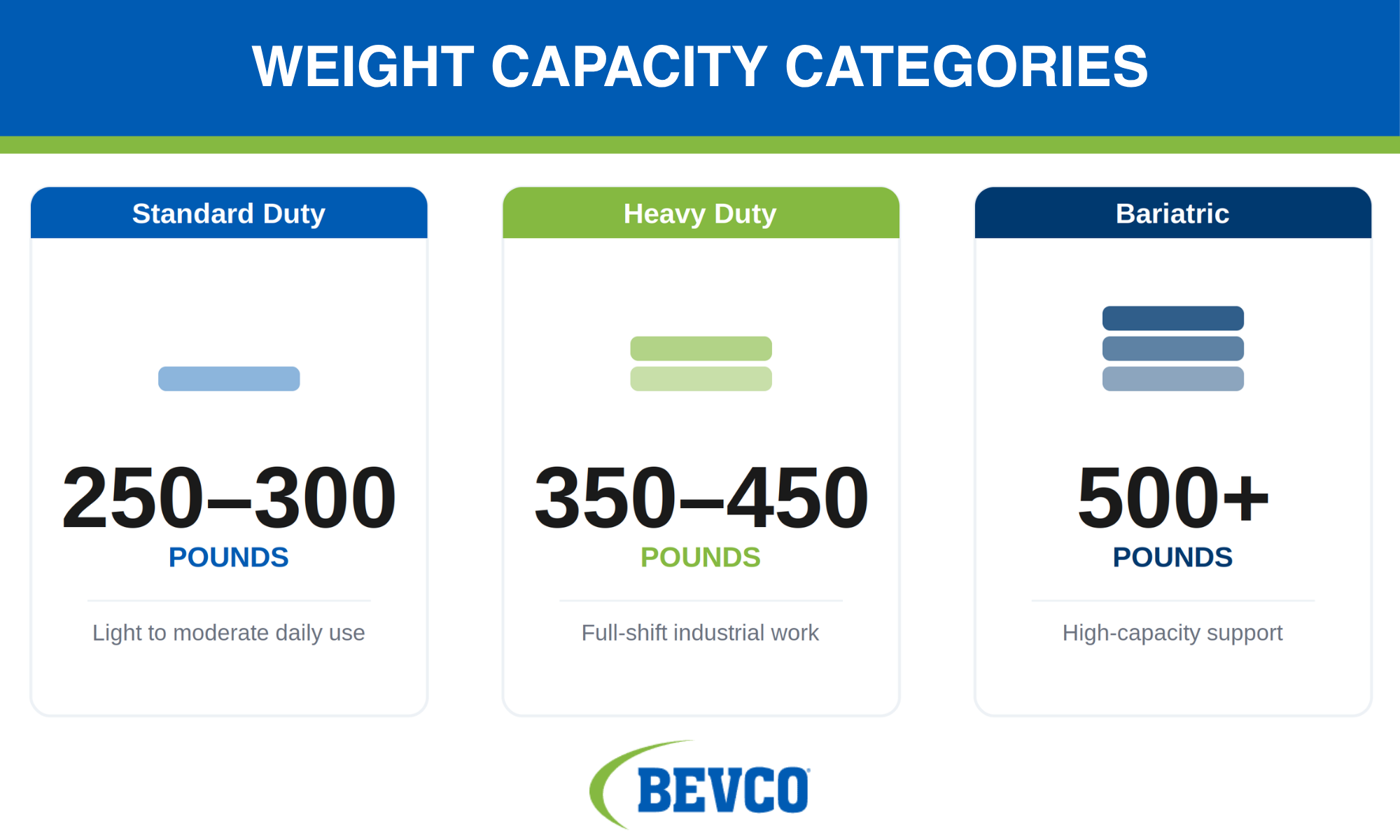
Common weight capacity categories include:
- Standard duty: 250–300 pounds
- Heavy duty: 350–450 pounds
- Bariatric models: 500+ pounds
Step 6: Decide Between Casters and Glides
Workstation tasks should determine which matters more: mobility or stability.
Casters
Casters are ideal when employees need to move frequently between work areas.
Benefits include:
- Improved mobility
- Greater flexibility
- Easier repositioning
Glides
Glides provide a stable foundation and minimize movement.
Benefits include:
- Increased stability
- Improved precision for detailed tasks
- Better performance on slippery surfaces
Common Mistakes to Avoid
A few missteps come up again and again:
- Buying on price alone and skipping the adjustments that matter for long shifts
- Putting a standard task chair at an elevated workstation, which leaves feet dangling
- Ignoring foot support and the strain it causes over a full day
- Choosing upholstery that cannot stand up to the oils, chemicals, or cleaning in your space
- Overlooking adjustability on chairs that several people share
Recommended Features Checklist
Before you buy, confirm the chair has:
- A seat height range that matches your work surface
- An adjustable footring, not a fixed one
- Adjustable lumbar and back support
- A seat material suited to your environment
- A weight capacity and base width sized for the user and the seat height
- Adjustable armrests, or none, depending on the task
- Environment-specific compliance where you need it, such as cleanroom-ready materials
- A warranty and access to replacement parts
The Long-Term Value of Quality Industrial Seating

Industrial seating should be viewed as an investment rather than a commodity purchase.
A well-designed drafting chair helps support employee comfort, improve productivity, reduce fatigue, and create a more ergonomic workplace. Over time, these benefits can contribute to greater employee satisfaction and a more efficient operation.
The most successful seating programs focus on matching the chair to the workstation, the environment, and the user. When those three factors align, organizations are far more likely to achieve a positive return on their investment.
Find the Right Industrial Drafting Chair
Selecting the right industrial drafting chair involves much more than choosing a seat with the correct height. The ideal solution must support the employee, withstand the work environment, and adapt to the specific tasks being performed.
By carefully evaluating workstation requirements, environmental conditions, ergonomic features, and durability needs, organizations can make informed purchasing decisions that benefit both employees and the business for years to come.
After all, when employees are comfortable, supported, and able to focus on their work, everyone benefits.
As an ergonomic chair maker with decades of experience, Bevco designs and builds the best made-to-order drafting chairs in the USA, with polyurethane and upholstery options for manufacturing, labs, studios, and offices.
Ready to find your fit? Use the Chair Configurator to build your chair, the Seat Height Calculator to match your work surface, and find a Bevco distributor. Contact us with questions before you buy.