
The Short Answer: ANSI/BIFMA is a benchmark for Chair Safety and Performance. ANSI/BIFMA standards are a set of voluntary performance benchmarks developed by the Business and Institutional Furniture Manufacturers Association (BIFMA) and accredited through the American National Standards Institute (ANSI). For chairs, the most widely referenced standard is ANSI/BIFMA X5.1, which covers general-purpose office chairs. These mechanical standards test a chair’s structural integrity, stability, and ability to hold up under repeated use. When a chair meets ANSI/BIFMA compliance, it means the product has been evaluated against rigorous durability standards for safety and long-term performance.
For buyers and decision makers responsible for outfitting workspaces, from office furniture setups to industrial spaces, BIFMA compliance offers a reliable way to compare furniture products on a level playing field. It takes the guesswork out of purchasing and provides buyer confidence that the chair you are investing in can handle real-world conditions.

What Do ANSI/BIFMA Standards Actually Test?
BIFMA standards are not a single pass/fail checkbox. The ANSI/BIFMA X5.1 standard includes 20 individual tests that evaluate different aspects of a chair’s construction and function. These tests are developed by technical committees made up of furniture industry professionals, and they simulate years of daily use in a lab setting. The tests were designed with an estimated product life of ten years based on single-shift usage, according to the official standard documentation.
Here is a breakdown of the key testing categories:
| Testing Category | What It Evaluates |
|---|---|
| Structural Integrity | Load-bearing capacity of the seat, back, and base under static force |
| Stability | Resistance to tipping during normal use and at the edges of the seat |
| Strength | Performance of the frame, joints, and welds under applied stress |
| Fatigue/Cycling | Repeated use simulation (e.g., 100,000+ recline cycles for backrest and tilt mechanisms) |
| Arm Strength | Ability of adjustable arms to handle downward and lateral force without failure |
| Caster/Base | Movement, swivel, and rolling performance under load |
| Drop Tests | Impact resistance when the chair is subjected to sudden force |
These tests cover a chair whether it is an executive chair with a swivel and tilt lock or a task stool with pneumatic seat height adjustment. The goal is to verify that the chair can support daily use without failure, regardless of construction materials or aesthetic design.
BIFMA Compliant vs. BIFMA Certified: Know the Difference
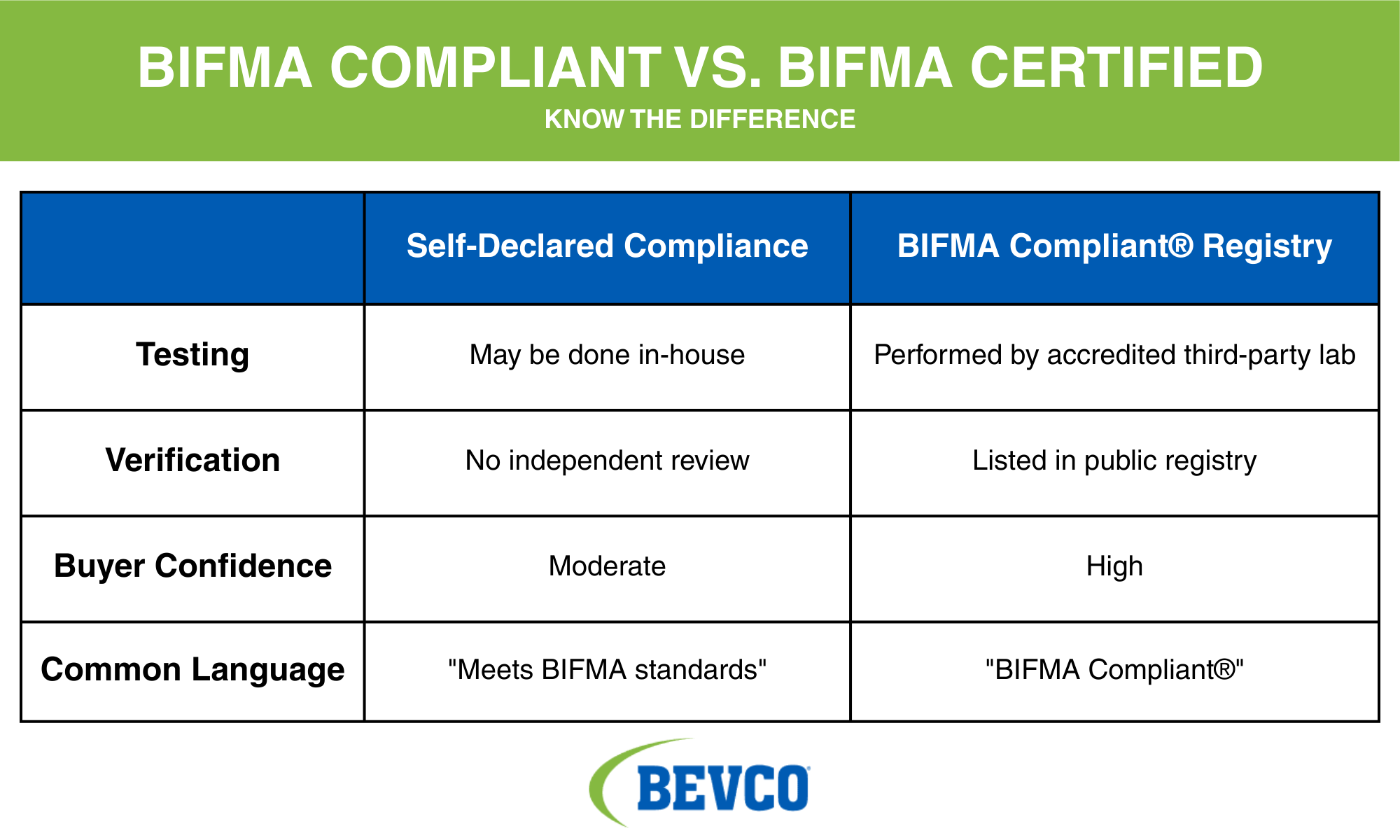
One of the most common points of confusion in the furniture industry is the difference between a chair that is “BIFMA compliant” and one that carries the BIFMA Compliant® mark. Understanding this distinction matters, especially for buyers making purchasing decisions for facilities, offices, or production environments.
BIFMA does not technically “certify” products. Instead, manufacturers voluntarily test their furniture products against BIFMA standards. A manufacturer can test a product internally and state that it “meets BIFMA requirements” in their marketing materials. While this is better than no testing at all, it lacks the verification that comes from independent, third-party evaluation.
The BIFMA Compliant® program goes a step further. Products listed in the BIFMA Compliant Registry have undergone third-party testing at an accredited lab and earned the compliant mark. This registry gives buyers a way to independently verify claims rather than relying solely on a manufacturer’s word. For decision makers who need documented proof of compliance for procurement, government contracts, or internal safety policies, the registry is a valuable resource.
Why BIFMA Compliance Matters for Your Workspace
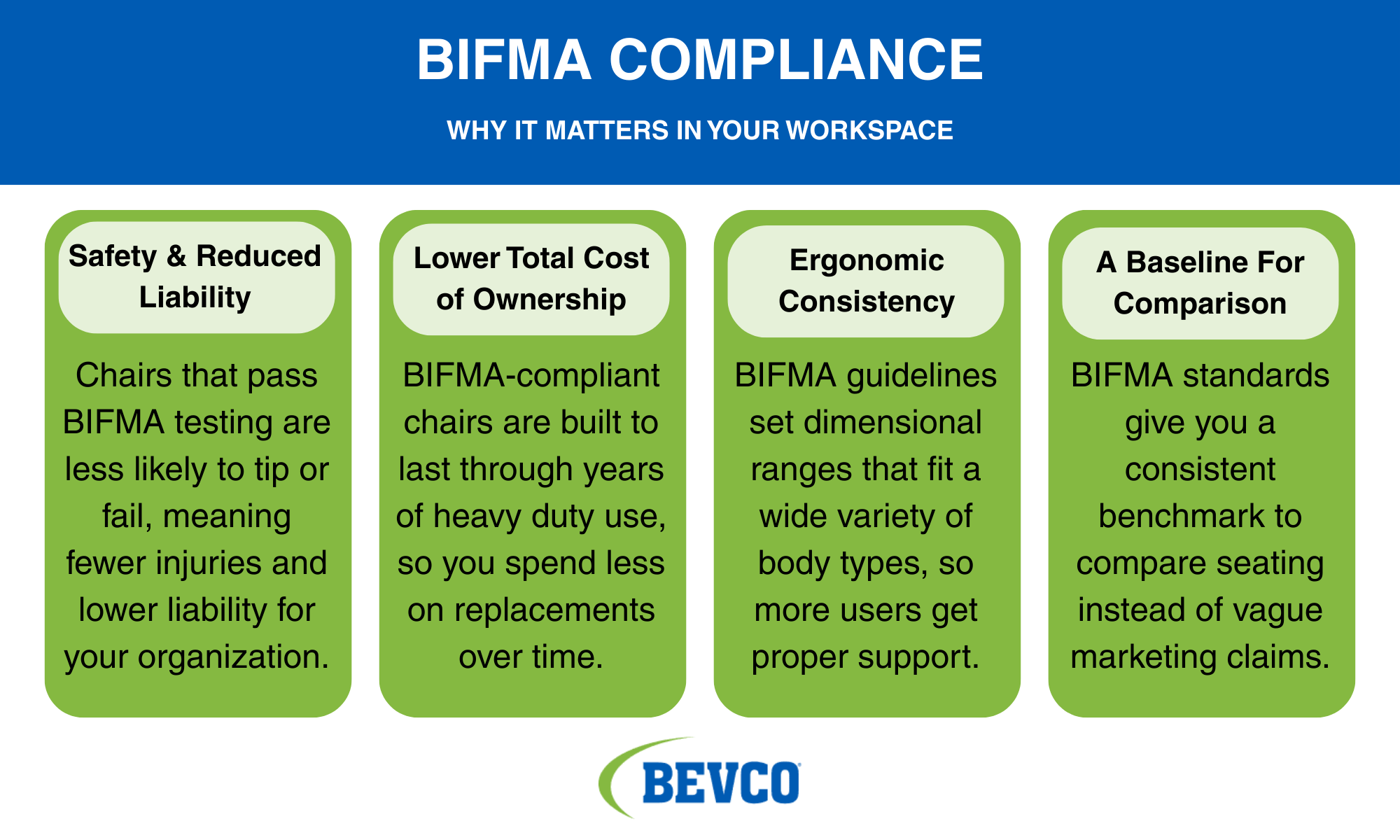
Whether you are purchasing a single ergonomic office chair for a home office, furnishing a conference room, or outfitting an entire production floor, BIFMA compliance has practical implications that affect your bottom line and the well-being of anyone using that chair.
Safety and reduced liability. BIFMA safety tests identify potential hazards before a product reaches your facility. A chair that passes stability and strength testing is less likely to tip, collapse, or fail during use. For organizations managing risk across hundreds of seats, this translates to fewer workplace injuries and lower liability exposure.
Lower total cost of ownership. A chair that withstands 100,000+ recline cycles in a lab is one that will not need replacement after a year or two of heavy duty use. BIFMA-compliant chairs tend to have longer service lives, reducing the cost of frequent replacements. When you factor in the weight capacity ratings, quality of pneumatic seat height adjustment levers, and overall frame construction that these standards demand, the upfront investment pays for itself over time.
Ergonomic consistency. BIFMA’s ergonomic guideline (G1-2013) provides dimensional ranges designed to fit body types from the 5th percentile female to the 95th percentile male. This means chairs built to these specs are more likely to offer proper lumbar support, appropriate seat height ranges, and adjustable features that accommodate a wide range of users spending long hours at a desk or workstation.
A level playing field for comparison. With so many online players and manufacturers offering seating, it can be difficult to compare products side by side. BIFMA standards give buyers a consistent framework. Instead of relying on vague claims about comfort or quality, you can ask specific questions: Does this chair meet ANSI/BIFMA X5.1? Is it listed in the compliant registry? What weight capacity was it tested to? These answers cut through the noise and help you make informed decisions.
Built to the Standard, Backed by Decades of Experience

At Bevco, we understand what BIFMA compliance means because we live it every day on our manufacturing floor in Waukesha, Wisconsin. As a family-owned company that has been building chairs since 1947, we have seen firsthand how standards like ANSI/BIFMA X5.1 separate well-built seating from products that simply look the part.
Our value-line seating options meet ANSI/BIFMA X5.1 furniture safety and performance standards, accommodate a generous 300 lb weight capacity, and come with a 5-year warranty. If you need a more robust seating solution that complies with the ANSI/BIFMA X5.11 large occupant seating standard, we offer several options for you to consider. Among these are our heavy-duty Dura Series, which have a weight capacity of 350 and are made from rugged polyurethane. Additionally, our fully adjustable Integra Series offers a cushioned seating experience with contoured lumbar support and waterfall seat edges, ensuring comfort and support. Every chair we make is engineered to meet the demands of real work environments. Bevco chairs are made-to-order, and we provide a variety of options in polyurethane, vinyl, and fabric upholstery to match the needs of your specific application.
We design seating for manufacturing, laboratory, healthcare, government, and education settings where chair failure is not an option. Our products are built with the same attention to safety, comfort, and long-term performance that BIFMA standards are designed to verify.
If you are evaluating seating for your facility and want to know that your chairs meet recognized performance benchmarks, we are here to help. Use our Chair Configurator to explore options, check our Seat Height Calculator to find the right fit for your workspace, or contact us directly. You can also find an authorized Bevco distributor or schedule a free chair demo to experience the difference for yourself.